Simuligne
A multi-organisation B2B SaaS in which employees practise professional conversations with an AI-simulated customer, then receive a traceable evaluation against explicit criteria.
- My role
- Product design and software architecture, end to end.
- Target stack
- TypeScript strict · Next.js · NestJS · PostgreSQL (RLS) · OpenFGA · Authentik · LiveKit · Stripe
- Status
- Design phase largely complete. Implementation planning next.
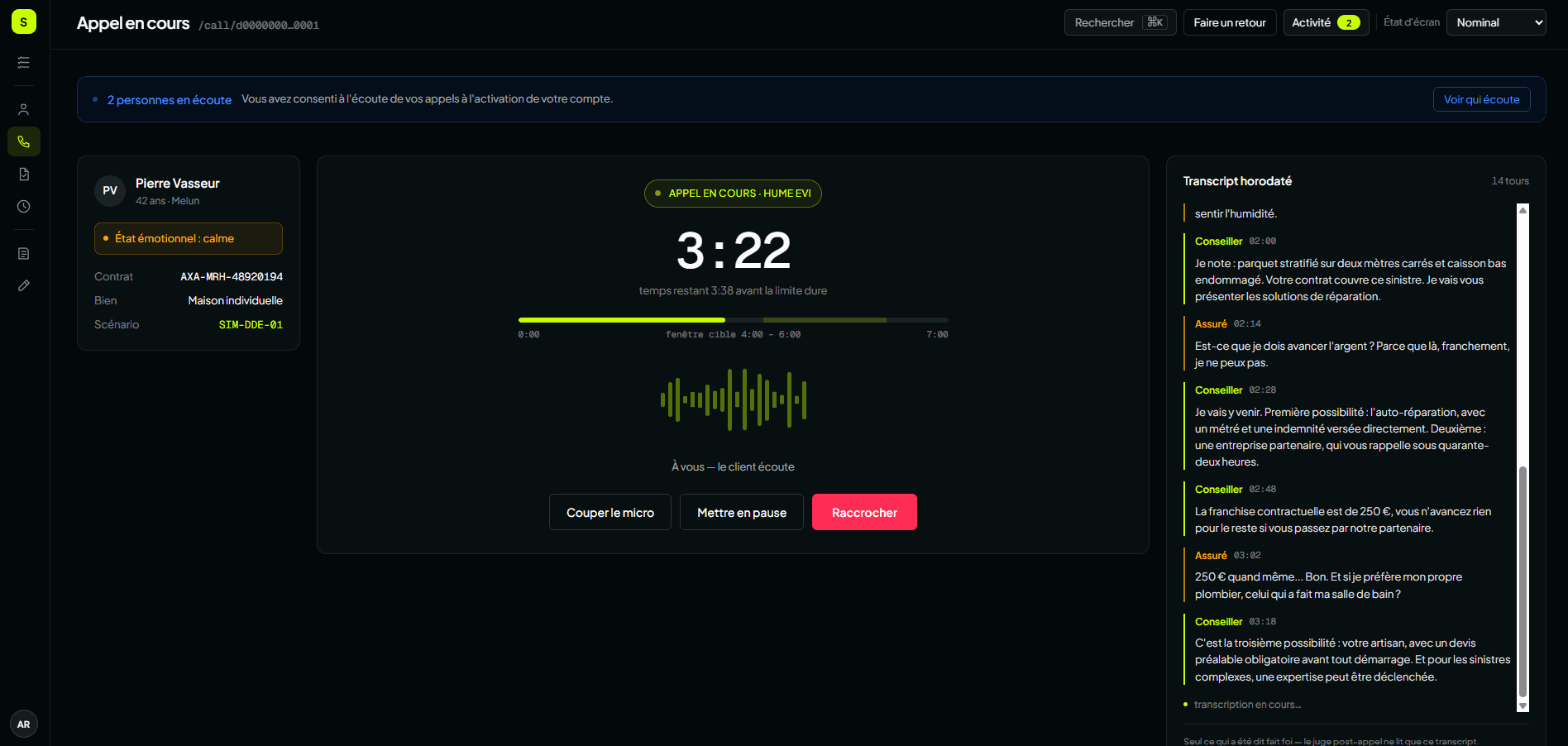
Customer advice, service, telesales and insurance all run on conversation, and the skill is built through practice. My operational experience showed how limited the usual options are.
- Peer role plays tie up trainers, are hard to repeat identically and hard to measure.
- Evaluation depends on the evaluator, with no explicit criteria or evidence tied to the exchange.
- Managers lack a structured view of progress by employee, team or site.
- Training content is rarely versioned or governed.
Simuligne lets companies train employees on realistic conversations with AI-simulated customers, assess skills against explicit criteria and track progress within a structured training path. Three engines form the core.
- Business scenarios
- Structured, versioned training content. A scenario is a validated business object, never a raw prompt.
- Voice conversation
- Real-time spoken exchange with the simulated customer on an assigned scenario.
- Evaluation
- Post-call analysis on a grid of observable criteria. Every conclusion points to specific evidence in the transcript.
Each role is limited to its own scope. Observers access through a signed link, without an account.
- 01A trainer writes a scenario.
- 02A quality lead validates it, and it is assigned to an adviser.
- 03The adviser takes up to three successive calls, confirming they have read the report between each one.
- 04The report links each criterion to its evidence, and managers track progress.
What I produced
Architecture
↔ voice runtimes
Every request passes through the same server-side guard chain. Tenant isolation is enforced by the database, so a forgotten application filter cannot leak data. The LLM proposes, policy decides.
Decisions that shaped the work
- 01Make the scenario, not the language model, the centre of the training experience.
- 02Keep recordings and transcripts reviewable so coaches can inspect a simulation rather than rely only on a summary.
- 03Separate conversation infrastructure from scenario design and training evaluation.
Technical choices
Each choice follows one template: X over Y because requirement R matters more than cost C, to be revisited if assumption A changes.
Live project progress / GitHub milestones
The build, in motion.
A direct view of the project plan. Milestone titles and issue counts come from the private Simuligne repository; only this progress summary is published here.
Loading project progress…
The platform is in development. Do not interpret illustrations, target scoring screens or scenario concepts as evidence of customers, deployed features or training outcomes.
A project worth discussing?
Engineering opportunities, technical collaboration, or a challenging problem worth exploring.