“Was my brand mentioned or cited?”
AI RETRIEVAL OBSERVABILITY · TRACE INTEGRITY · VERIFIED REMEDIATIONFor business owners, marketing leaders, and digital teams
Can AI systems find, understand, and use your business?
Most AI visibility tools show the final mention. Agent View shows what happened before it—and what you can actually improve.
From visibility to evidence
Your business can be visible and still lose the source selection.
Agent View checks whether your content is reachable, whether it survives retrieval, whether it supports the claims buyers care about, and where competing sources win instead.
01ReturnedObserved
02Selected & OpenedObserved
03Actually ReadVerified
04Used or RejectedExplained
05Cited in AnswerTraced
A citation tells you the outcome. It does not tell you why your business entered—or disappeared from—the chain.
Agent View turns that blind spot into a set of understandable reports, human-reviewed priorities, and before-and-after evidence.
Our positioning
Not Another AI SEO Dashboard
“What was returned, what was opened, what was actually read, what was rejected, what was used, and where did the chain fail?”
Category Matrix
A Different Category
| Dimension | AI Visibility / Agent SEO | Agent View |
|---|---|---|
| Primary question | Was the brand mentioned or cited? | How did the source move through the retrieval chain? |
| Position in funnel | Final outcome | Returned → selected → fetched → validated → used → cited |
| Main output | Visibility score, mentions, citation count | Evidence ledger, technical findings, model variance, integrity verdict |
| Evidence | Observed answer or citation | Search candidates, fetch records, validation decisions, rejected sources |
| Technical delivery | Usually outside the product | Access, extraction, rendering, structure, freshness, and safety |
| Reasoning claim | May infer why a source won | Does not claim access to hidden reasoning |
| Verification | Dashboard observation | Programmatic integrity checks over an append-only trace |
| Next action | Optimize content visibility | Diagnose, validate, correct, and re-test |
| Promise | Improve or monitor visibility | Make retrieval behavior inspectable — never guarantee citations |
What Agent View Does Not Claim
No Hidden Reasoning Access
Agent View inspects what AI models receive and return. It does not claim access to internal model reasoning, attention weights, or chain-of-thought processes.
No Guaranteed Citations
Agent View makes retrieval behavior inspectable. It never guarantees that a model will cite a source, only that the source was delivered and extractable.
No Forced Remediation
Reports inform and surface issues. They do not auto-fix websites or force changes. Remediation decisions remain with the site owner.
Architecture
The Retrieval Evidence Stack
What the website makes technically available
A deterministic audit measuring access, extractability, render independence, structure, freshness, and safety — before any model is asked to judge the content.
Multi-agent simulation of source selection
A controlled multi-agent simulation recording returned, selected, fetched, validated, rejected, used, and cited sources. Measures model variance and the snippet-to-content gap.
Layer 1 — What the Website Delivers
01. Access
Reachability
Can automated systems reach the important content?
02. Extractability
Clean Content
Can main info be separated from markup, nav, and noise?
03. Rendering
Render Independence
Does content exist in initial HTTP response or only after JS?
04. Structure
Freshness & Schema
Can info be identified, attributed, and checked for change?
05. Safety
Surface Protection
Does the machine surface expose anything it should not?
Format validation is not enough. Does it deliver?
When a site publishes llms.txt, Agent View follows declared links checking dead links, HTML vs clean text, content overhead, missing pages, and drift.
100/100 readiness reachable without index-ai
Agent View does not include index-ai in its score. The correct fix may be SSR, prerendering, structured data, or no change at all.
Empirical Benchmark Audit · 50,665 Links Audited
Autopsy V4 Benchmark: A declared URL is not proof of AI readability.Discovery is Not Delivery
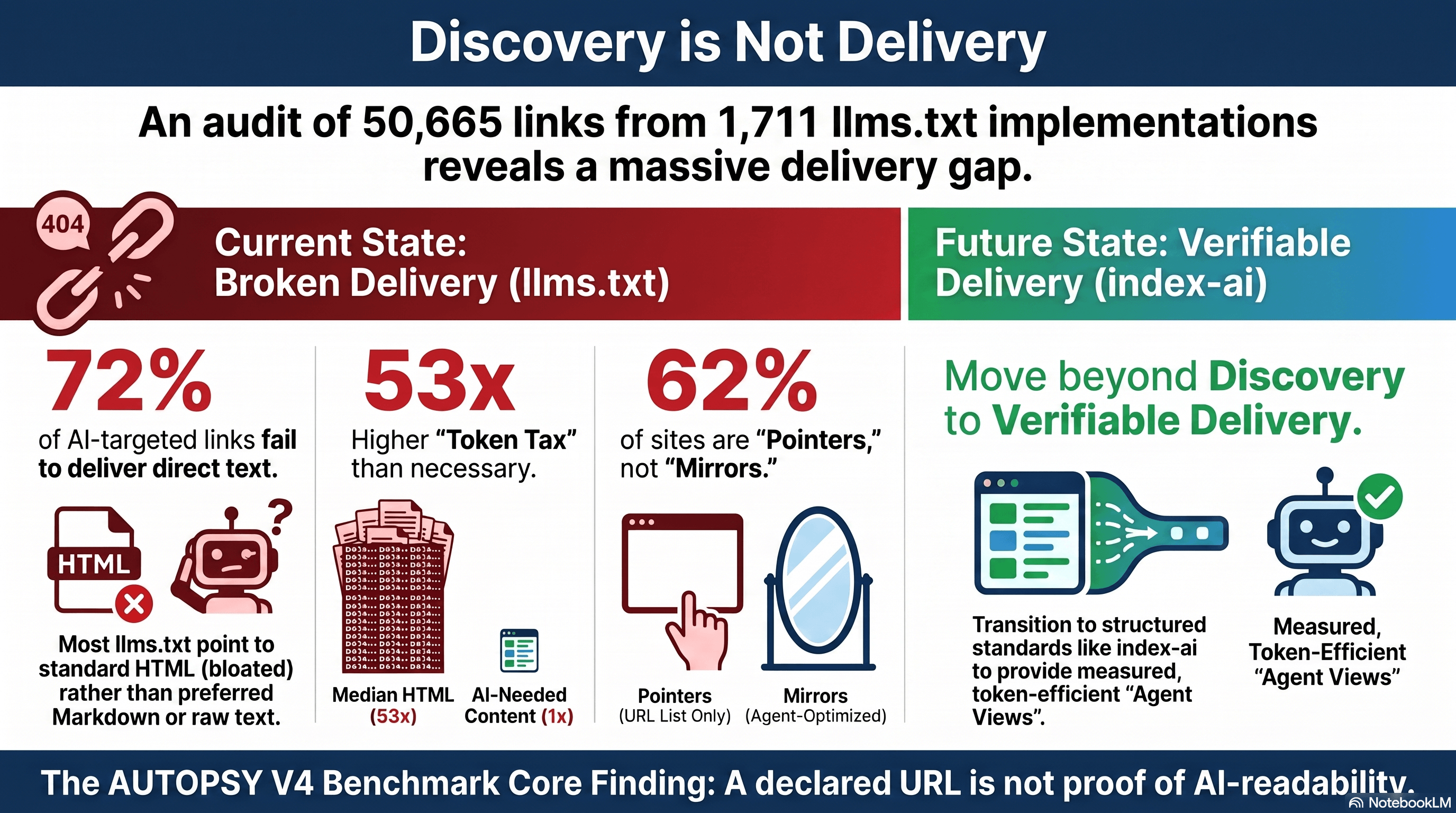
72%Fail to deliver direct text (HTML bloat)
53xHigher "Token Tax" than necessary
62%Sites are "Pointers", not "Mirrors"
index-aiVerifiable delivery standard
Simple process
You provide the surface and business questions. Agent View turns it into evidence, human review, and action.From Question to Business Decision
Stage 01
Spot weak access & delivery
Agents audit your public pages continuously, isolating delivery leaks before buyers ask AI assistants about your brand.
AV
How has our repeat content access score trended over the past week?
Extractability conversion dropped 14% on client-rendered JS routes — here is the breakdown.
Extractability conversion dropped 14% on client-rendered JS routes — here is the breakdown.
Stage 02
Build verification playbooks
Configure reusable playbooks with automated triggers, steps, and guardrails across your entire content catalog.
Build Brief & Experiment Design
ActiveSet up goals, guardrails, success metrics
VerifiedDraft llms.txt & pull from CMS
ReadyStage 03
Automate recurring work
Autonomous agents execute 24/7 audits, adjusting live endpoints and refreshing structured feeds automatically.
1
ENTRY SOURCE → DATAWAREHOUSESyncing 50,000+ public index routes
2
REFRESH LLMS.TXT & SSR ENDPOINTSAuto-regenerating markdown structured feeds
Stage 04
Automate manual approvals
Agents route each decision to Slack or Teams, allowing your team to review, approve, or request changes in seconds.
Auxia Agent 9:12 AMApproval Needed
Approval needed — Repeat Purchase Content Refresh is ready.
Recommended: Low risk for initial distribution to GPT-4o & Claude 3.5.
Recommended: Low risk for initial distribution to GPT-4o & Claude 3.5.
Stage 05
Deliver 1:1 optimization at scale
Ranks content and timing for each AI crawler in real-time, serving clean context for every buyer query.
ChatGPT / GPT-4oSSR Stream✓ Cited & Used
Claude 3.5llms.txt✓ Cited & Used
Perplexity AISearch Stream⚡ Remediated
Choose the evidence you need
Start free. Add human or multi-model evidence when the decision requires it.More Than One Type of Report
Website Readiness ReportFree starting point
Can automated systems access and extract your key page?
A deterministic scan of one public URL, designed to identify delivery risks before any AI model is asked to judge the content.
llms.txt Delivery ReportFor llms.txt adopters
Does your llms.txt file deliver what it promises?
We follow declared links checking dead links, HTML vs clean text, content overhead, missing pages, and drift.
Retrieval Evidence ReportControlled multi-model trace
When buyers ask real questions, does your business enter the source chain?
Controlled multi-model run recording returned, opened, used, rejected, and cited sources for your buyers' exact questions.
Human Readiness Review (€490)Decision support
Which findings matter to the business—and what should be fixed first?
A human review validates evidence, removes false positives, focuses on priority pages, and outputs a prioritized action plan.