AI Manifest
/.well-known/index-ai.json
Single HTTP call declaring identity, publisher role, freshness timestamps, usage policies, and discovery links.
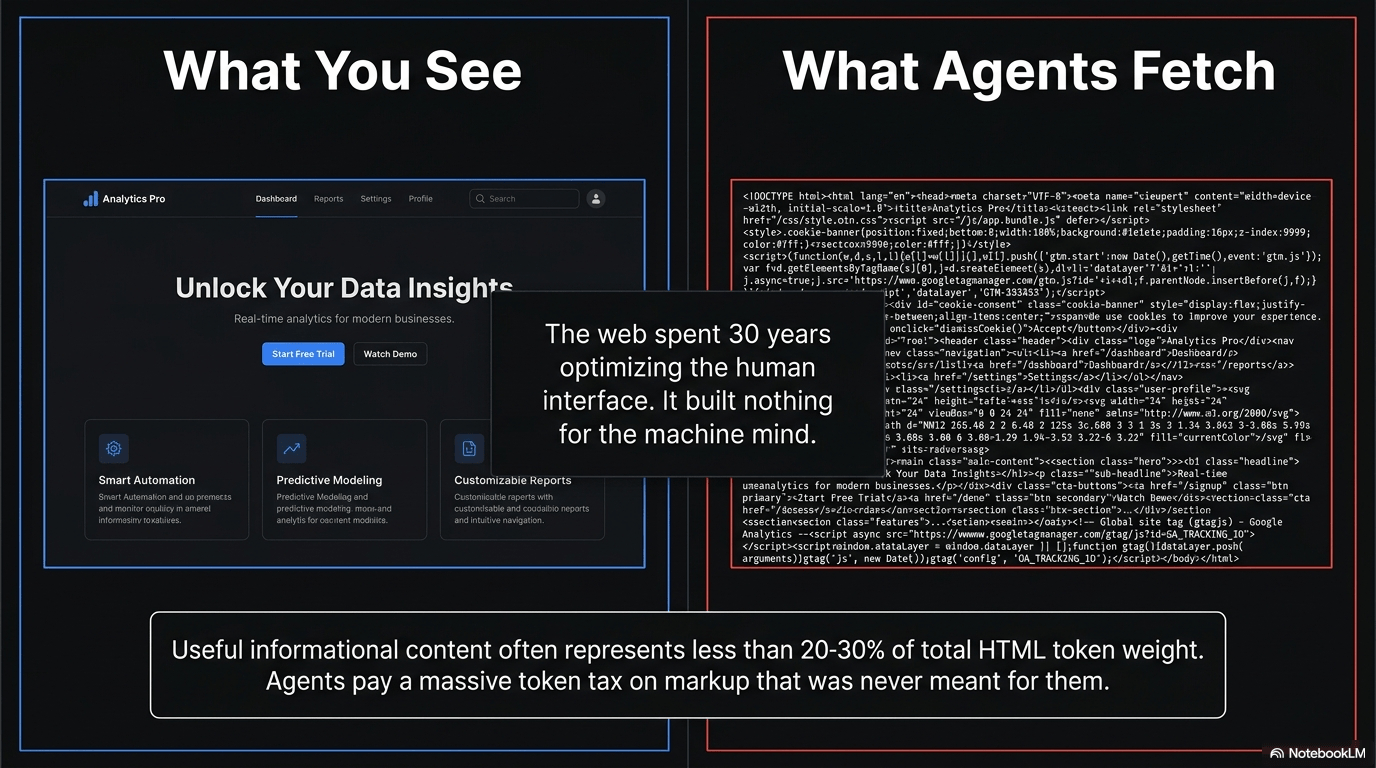
⚡ ~15 min implementation Websites were built for human eyes. index-ai gives AI agents a parallel, structured, and token-efficient interface — from AI Manifests to Navigable Agent Graphs.
The gap index-ai closes: only 28% of 50,665 declared links deliver text directly — see AUTOPSY V4
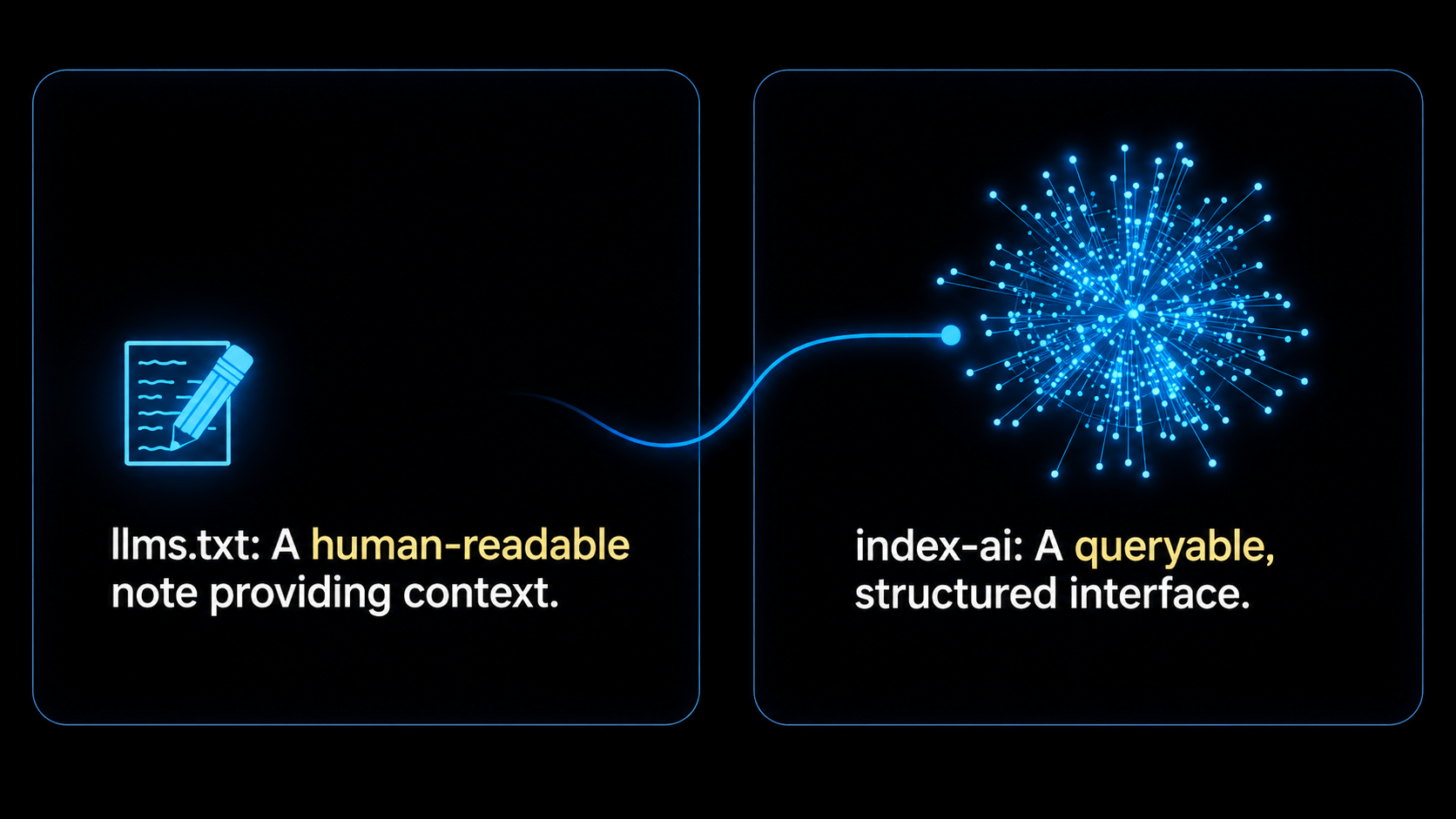
llms.txt is a note for LLMs. index-ai is an interface for agents.” In 2013, React introduced the Virtual DOM because the browser's visual DOM was too expensive to manipulate directly. index-ai applies the exact same principle to websites: HTML/CSS/JS is the Human Interface; Agent View is the Agent Interface.
Built for visual hierarchy, layout rendering, styling, and user interaction.
Built exclusively for machine consumption, semantic graph traversal, and token budgeting.
/.well-known/index-ai.json
Single HTTP call declaring identity, publisher role, freshness timestamps, usage policies, and discovery links.
⚡ ~15 min implementation/agent-index.json
Flat array of content nodes with clean text endpoints (llm_url) and measured code point bounds (content_chars).
⚡ ~2 hour implementation/agent-index.json + relations
Extends Level 2a with typed relationships (parent, children, related) forming a valid Directed Acyclic Graph (DAG).
👑 Full Graph NavigationMCP Server
Exposes a parameterized Model Context Protocol (MCP) server allowing agents to execute live typed queries over site data.
🚀 Dynamic Tool Execution"$schema": "https://raw.githubusercontent.com/index-ai/standard/main/schema/v1/index-ai.schema.json", "spec_version": "1.0", "manifest_version": 1, "identity": { "name": "Atlas Hotels", "description": "Real-time hotel booking covering 12 cities in Morocco. 247 hotels.", "domain": "atlashotels.ma", "category": ["hotels", "booking", "travel"] }, "publisher": { "name": "Atlas Hotels SAS", "role": "official-platform", "contact": "[email protected]", "verification_hint": "dns-txt" }, "freshness": { "content_updated_at": "2026-07-29T14:30:00Z", "refresh_frequency": "continuous", "valid_until": "2026-12-31T23:59:59Z" }, "policy": { "usage_preferences": { "search": true, "summarization": true, "citation": true }, "citation": { "required": true } }, "access": { "agent_index": "/agent-index.json", "llms_txt": "/llms.txt" }
@hardmachinelabs/index-ai-validator The official reference validator CLI tests any domain against all 4 levels of the specification — verifying JSON schemas, DAG acyclicity, content_chars code point precision, secret leaks, and publisher verification hints.
Verification date: 2026-07-29 · Readiness Score: 100% · 0 failures, 0 critical errors
| Standard / Feature | Question Answered | Format | Agent Interface Capability | index-ai Alignment RECOMMENDED |
|---|---|---|---|---|
| robots.txt | "Where may crawlers go?" | Text File | Access permissions only. No content, no structure. | Additiveindex-ai respects robots.txt restrictions as primary authority. |
| sitemap.xml | "What URLs exist?" | XML | URL list for search engines. No clean text, no token bounds. | AdditiveSitemap discovers URLs; index-ai structures content & pre-measures token cost. |
| llms.txt | "Here is context for LLMs" | Markdown | Human-readable markdown note. Not a queryable JSON schema. | Bridgellms.txt is a note; index-ai is a queryable interface. |
| Schema.org | "What entities are in this page?" | JSON-LD | Page-scoped entity metadata. No site-wide graph or clean endpoints. | ComplementarySchema.org describes in-page entities; index-ai structures the site graph. |
| ★ index-ai (L1–L3) | "What is this site, what content exists, and how much will it cost to fetch?" | JSON + MCP | Full Agent View: Manifest + DAG Nodes + Pre-fetch summaries + Exact content_chars. | Complete StandardThe Complete Open Interface for Agents. |
The conformance ladder. Selected Level: Level 1 — AI Manifest (/.well-known/index-ai.json). Copy the coding agent prompt below.
You are a senior web engineer. Implement Level 1 of the index-ai v1.0-rc1 specification on this website.

Requirements:
1. Create a JSON manifest served at `/.well-known/index-ai.json` (RFC 8615), with a fallback alias at `/index-ai.json`. Content-Type `application/json`, UTF-8, hard max 50 KB (10 KB RECOMMENDED).
2. Schema:
   - spec_version: "1.0", manifest_version: 1 (integer, bump whenever content changes)
   - identity: name, description (factual, written for an LLM consumer -- MUST NOT contain marketing superlatives), domain, category [] (lowercase slugs, `[a-z0-9-]+`), language [], geo (optional)
   - publisher: name, role ("official-platform" | "publisher" | "aggregator" | ...), contact, verification_hint ("dns-txt" | "meta")
   - freshness: content_updated_at (ISO-8601 -- MUST reflect the real last content update, NEVER the manifest/deploy/build timestamp), manifest_generated_at, refresh_frequency ("static" | "daily" | "weekly" | "monthly" | "continuous"), valid_until, cache_max_age_seconds
   - policy: usage_preferences (search, summarization, citation, agent_navigation, training, commercial_reuse -- these are real content-licensing decisions; `training` in particular MUST be an explicit choice confirmed with the site owner, never silently defaulted), citation (required, preferred_format), rate_limits (advisory only -- MUST still be enforced at the infrastructure level, this field does not enforce anything itself)
   - entrypoints []: at least one { topic, description, url, params }, pointing agents at your main content area(s)
   - access: agent_index ("/agent-index.json"), llms_txt ("/llms.txt")
   - llm_instructions: free text, factual and operational, MUST NOT exceed 500 characters
3. Discovery: add `<link rel="agent-manifest" href="/.well-known/index-ai.json" type="application/json">` to every page's `<head>`, add an HTTP `Link: </.well-known/index-ai.json>; rel="agent-manifest"` response header, and append `Agent-Manifest: /.well-known/index-ai.json` to `robots.txt`.
4. Generate this file at build/deploy time for static or infrequently-changing sites -- do not compute it per-request unless your content genuinely changes continuously. Once your coding agent has committed the implementation files, run the official reference validator to verify schema compliance, DAG graph integrity, content_chars NFC code point accuracy, and generate a standalone HTML Audit Report.
Want to see what signals AI models (ChatGPT, Claude, Perplexity, DeepSeek) actually use when extracting facts from your site? Run a free local delivery scan or launch a full retrieval evidence trace on Agent View.
Runs the validator's scan command to evaluate site reachability, extractability, visual gap, and signal-to-markup ratio in 60 seconds.
Test your site live on agent-view.com. See the split-screen Visual Gap, trace search candidate selection, inspect rejected sources, and verify model retrieval evidence.