Building the Case for a Battery Industry in the DRC
I co-founded Atlanta Compa International and led a CAPEX/OPEX feasibility study for a complete solid-state battery value chain in the Democratic Republic of Congo: ten plants, stakeholders in seven countries, one shared document. The most ambitious project I have led — and it stopped before financing closed.
- Company
- Atlanta Compa International · London
- Role
- Co-founder & Project Lead
- Period
- Nov 2018 – Jul 2021
- Deliverable
- 25-page CAPEX/OPEX report
industrial plants scoped, from raw feed to solid-state cells
countries of industrial stakeholders coordinated remotely
upper bound of the first-pass CAPEX envelope ($6.3–7.7B), to be confirmed by PFS/DFS
rounds of investor meetings held on the final report
The DRC holds the minerals. The value was added elsewhere.
Lithium, cobalt, copper and manganese are abundant in the DRC, but they leave the country as raw concentrate. Atlanta Compa International proposed The Vision to Johnson Battery Technologies: build the industrial ecosystem locally, from refining to cell manufacturing, and lay the foundation for a Congolese and African battery industry.
The technology bet was solid-state: cells from Excellatron Solid State (a JBT company, USA), with modules, packs and BMS from Steatite (UK).
- 01Mine
Raw feed: spodumene, tailings, MHP/MSP, Mn ore (Kisenge)
- 02Refine
Refineries: Mn, Ni, Co sulphates, Li hydroxide/carbonate, sulphuric acid
- 03Convert
Precursors: cathode precursor (P-CAM), Li-metal anode
- 04Build
Components: electrolyte, separator, current collectors
- 05Assemble
Battery: solid-state cells, modules, packs, BMS
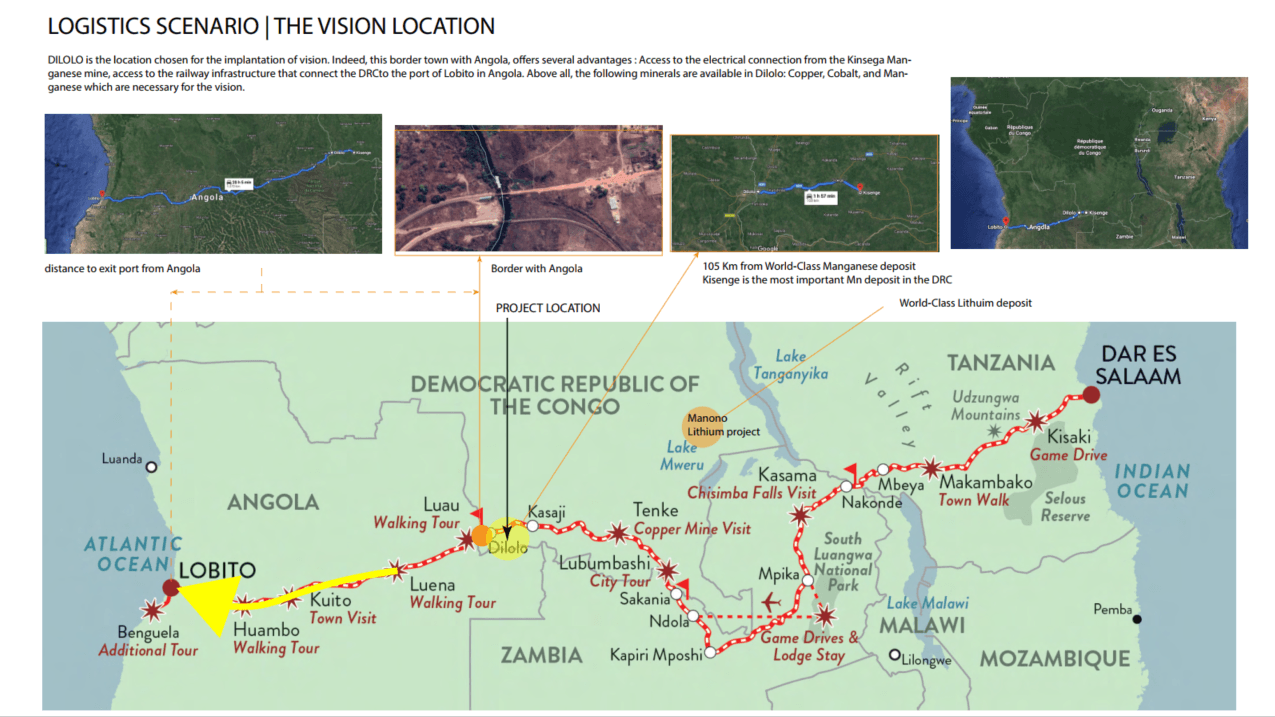
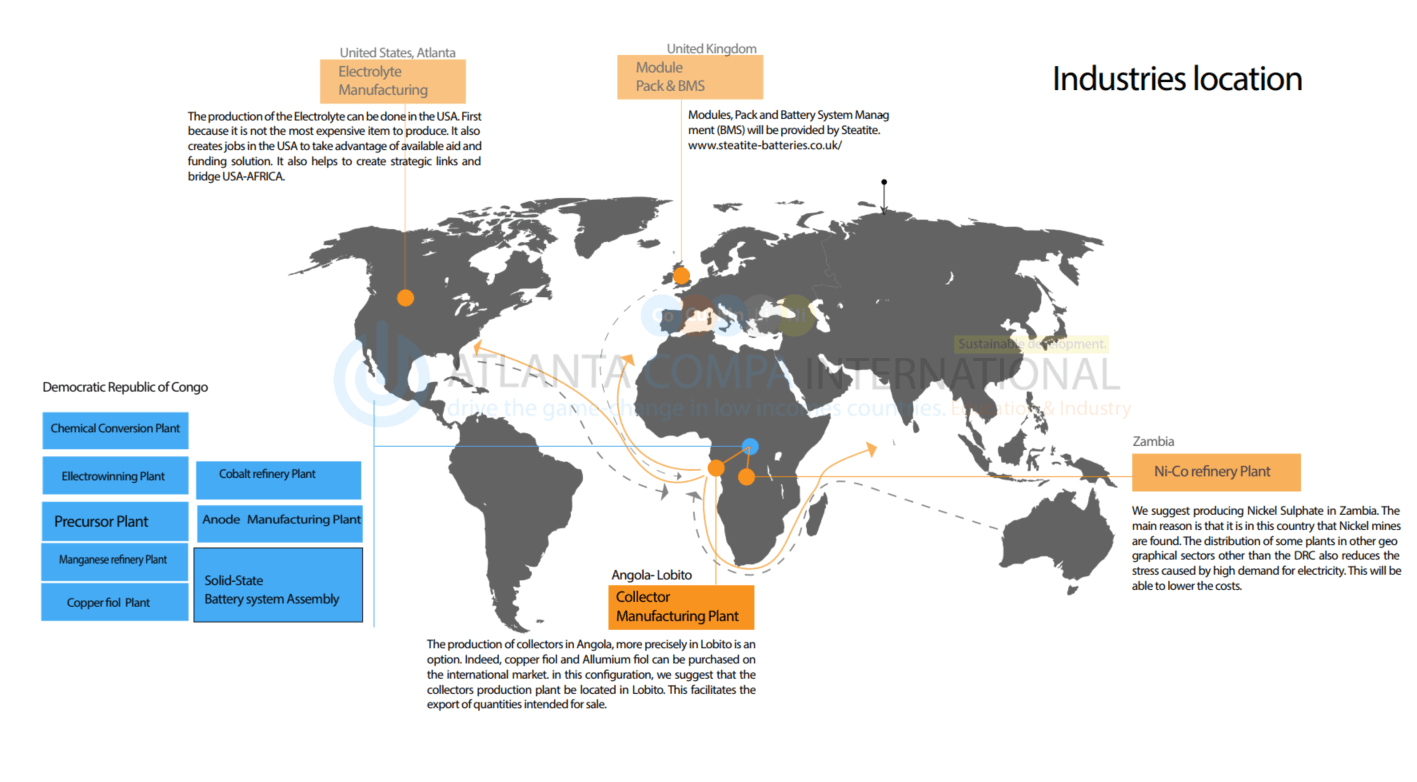
Ten plants in total: seven in the DRC around Dilolo on the Angolan border, near the Lobito rail corridor, and three abroad — the nickel refinery in Zambia, current collectors in Lobito (Angola) and electrolyte in the USA.
Carrying a project without any authority over the people in it
Atlanta had two partners, one in the DRC and one in France. Every other industrial participant joined because I found them through cold outreach and convinced them the project was worth their time.
Built the network
Identified and engaged players across the whole chain, from mining companies to battery production engineers.
Coordinated remotely
Ran the meetings and synchronised information needs between stakeholders across time zones and disciplines.
Went to the field
Visited mining sites and travelled the road network before writing a line of the logistics scenario.
Wrote the study
Produced the final CAPEX/OPEX report and contributed to the investor pitch.
Estimates you can trace back to a real project
No plant in this chain existed yet in the DRC, so every figure was anchored to published feasibility studies of plants already producing or in development (PEA, PFS, DFS). For each input metal, I laid out alternative supply scenarios and priced each one, and I stated the assumptions explicitly.
The study also covered power supply (DRC capacity is ~99% hydro), heat recovery across plants and circular-economy savings. All figures were flagged as to be confirmed by PFS/DFS.
- 2018Project launchedVision shared with Johnson Battery Technologies; network building begins.
- ThroughoutField work and scenario designSite visits, supply and logistics scenarios, CAPEX benchmarking.
- May 2021Final report deliveredTwo rounds of favourable investor meetings, backed by a major law firm.
- 2021Project haltedStopped by the pandemic and the geopolitical context before financing closed. No plant was ever built: the study is the deliverable.
A number is only useful if someone else can trace where it came from. That rule came from this study, and I still apply it to the software I build.
Influence without authority
Keeping volunteers from seven countries aligned for three years.
Structure under uncertainty
Breaking an unbounded problem into scenarios that can be compared.
Ground truth first
Checking roads and sites before trusting the spreadsheet.